Chapter 01
Your Home’s Comfort System: The Big Picture
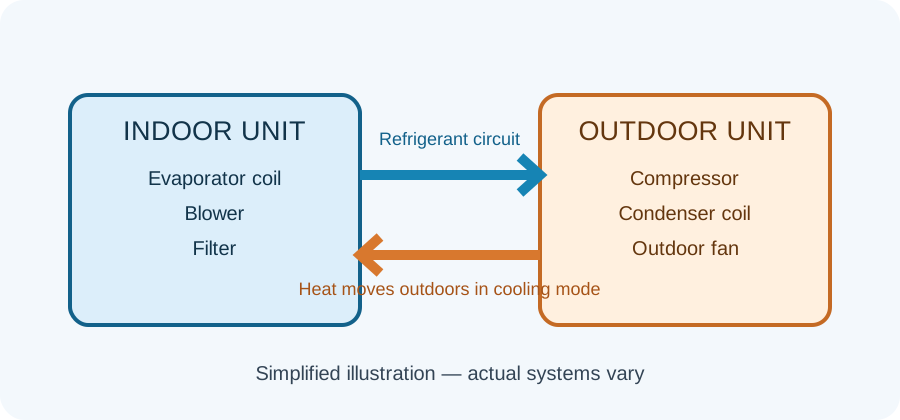
An air-conditioning system does more than make the air feel cold. A central home comfort system moves air, transfers heat, removes some moisture, filters particles, and responds to the thermostat. Understanding those jobs makes it easier to describe a problem and ask useful questions when a technician visits.
In a typical split central-air system, the indoor equipment contains an evaporator coil and blower. The outdoor unit contains a compressor and condenser coil. Refrigerant circulates through the system and carries heat from indoors to outdoors. The blower moves household air across the indoor coil and sends the conditioned air through supply ducts. Return ducts bring air back to the equipment.
The thermostat is the control, not the cooling system itself. It measures conditions at its location and tells the equipment when to operate. A thermostat in a sunny hallway or near a supply register may not represent how the whole home feels.
The duct system matters just as much as the equipment. Leaky, disconnected, poorly insulated, or restricted ducts can make rooms uncomfortable even when the outdoor unit is running. Airflow depends on properly sized ducts, open registers, clean filters, and a blower operating as designed.
A home may use a heat pump, a straight-cool air conditioner with separate heat, a package unit, or a ductless mini-split. The right maintenance and operating instructions depend on the actual equipment. Find the model and serial numbers, keep the owner’s manuals, and ask a qualified technician to explain the system installed in your home.
A useful first step is to identify the indoor unit, outdoor unit, thermostat, filter location, and main return-air grilles. Do not remove service panels or reach into equipment. Simply knowing where the components are will help you communicate clearly.
First Coast homeowner note: A useful first conversation
When describing a comfort problem, tell the technician which rooms are affected, when the issue began, and whether it changes during the day. Those details are more useful than simply saying the system “doesn't feel right.”
Editorial sample for this fictional demonstration brand.